Baby Weight Chart By Month In Kg: 0–12 Month Complete Guide (Boys & Girls)
I still remember the feeling — watching the nurse slide the weight counter on that old clinic scale and then looking at the pediatrician’s face for any sign. That moment, when you are holding your breath waiting to know if your baby is growing well, is one the most universal experiences of new parenthood. Whether you are a first-time parent in London, Lagos, or Lucknow, that quiet worry about whether your baby is gaining enough weight is something almost every parent knows.
The good news is that baby weight ranges are not as mysterious as they feel in those early weeks. Most babies follow a predictable pattern — one that researchers have studied across dozens of countries. This guide breaks down the baby weight chart by month in kg, explains what the numbers really mean, and helps you move from anxiety to clarity.
One important note before we dive in: every baby has their own growth curve. The charts below are reference points, not finish lines. A baby sitting at the 25th percentile is not behind — they are simply smaller, and likely always will be, just like their parents.
In This Guide
- → What Weight Standards Are Used Worldwide?
- → Baby Boy Weight Chart (0–12 Months)
- → Baby Girl Weight Chart (0–12 Months)
- → Month-by-Month Growth Milestones
- → Understanding Percentiles
- → What Affects Baby Weight?
- → How to Weigh Your Baby at Home
- → When to Talk to a Doctor
- → More Baby Growth Guides
- → Common Questions Answered
What Weight Standards Are Used Worldwide?
Most pediatricians across the world — whether in the US, UK, Australia, or India — use the same growth reference: the World Health Organization (WHO) Child Growth Standards, published in 2006. These standards were built by tracking healthy, breastfed children from six different countries (Brazil, Ghana, India, Norway, Oman, and the United States) under optimal nutrition conditions.
Because the data came from multiple ethnicities and regions, the WHO charts represent a truly global baseline for how healthy infants grow — not specific to any one country. If your pediatrician plots your baby’s weight on a chart, this is almost certainly the reference they are using.
The numbers in the tables below reflect those WHO standards. The “Average” column shows the 50th percentile weight — meaning half of healthy babies weigh more and half weigh less at that age. The “Normal Range” reflects the 3rd to 97th percentile. Babies anywhere within that range are considered medically healthy.
Quick Note: If your baby was born before 37 weeks, their weight should be tracked using their “corrected age” (based on due date, not birth date). See our premature baby weight chart for details.
Baby Boy Weight Chart By Month In Kg (0–12 Months)
Boys tend to be slightly heavier than girls at birth and maintain that difference through the first year. The table below shows the expected weight range for baby boys from birth to 12 months.
| Age | Average Weight (50th Percentile) |
Normal Range (3rd – 97th %ile) |
|---|---|---|
| Birth | 3.3 kg | 2.5 – 4.3 kg |
| 1 Month | 4.5 kg | 3.4 – 5.7 kg |
| 2 Months | 5.6 kg | 4.3 – 7.1 kg |
| 3 Months | 6.4 kg | 5.0 – 8.0 kg |
| 4 Months | 7.0 kg | 5.6 – 8.7 kg |
| 5 Months | 7.5 kg | 6.0 – 9.3 kg |
| 6 Months ★ | 7.9 kg | 6.4 – 9.8 kg |
| 7 Months | 8.3 kg | 6.7 – 10.3 kg |
| 8 Months | 8.6 kg | 6.9 – 10.7 kg |
| 9 Months | 8.9 kg | 7.1 – 11.0 kg |
| 10 Months | 9.2 kg | 7.4 – 11.4 kg |
| 11 Months | 9.4 kg | 7.6 – 11.7 kg |
| 12 Months (1 Year) ★ | 9.6 kg | 7.7 – 12.0 kg |
★ Key milestone months. Source: WHO Child Growth Standards (2006), Weight-for-age, Boys.
Baby Girl Weight Chart By Month In Kg (0–12 Months)
Girls typically weigh slightly less than boys at birth but follow the same general growth curve through the first year. The ranges below apply to healthy, full-term baby girls worldwide.
| Age | Average Weight (50th Percentile) |
Normal Range (3rd – 97th %ile) |
|---|---|---|
| Birth | 3.2 kg | 2.4 – 4.2 kg |
| 1 Month | 4.2 kg | 3.2 – 5.4 kg |
| 2 Months | 5.1 kg | 3.9 – 6.6 kg |
| 3 Months | 5.8 kg | 4.5 – 7.5 kg |
| 4 Months | 6.4 kg | 5.0 – 8.2 kg |
| 5 Months | 6.9 kg | 5.4 – 8.8 kg |
| 6 Months ★ | 7.3 kg | 5.7 – 9.3 kg |
| 7 Months | 7.6 kg | 6.0 – 9.8 kg |
| 8 Months | 7.9 kg | 6.3 – 10.2 kg |
| 9 Months | 8.2 kg | 6.5 – 10.5 kg |
| 10 Months | 8.5 kg | 6.7 – 10.9 kg |
| 11 Months | 8.7 kg | 6.9 – 11.2 kg |
| 12 Months (1 Year) ★ | 8.9 kg | 7.0 – 11.5 kg |
★ Key milestone months. Source: WHO Child Growth Standards (2006), Weight-for-age, Girls.
👧 Looking for toddler girl weight? Once your daughter crosses her first birthday, see our dedicated 2-year-old baby girl weight guide for ages 12–36 months.
📌 Save This Chart to Pinterest
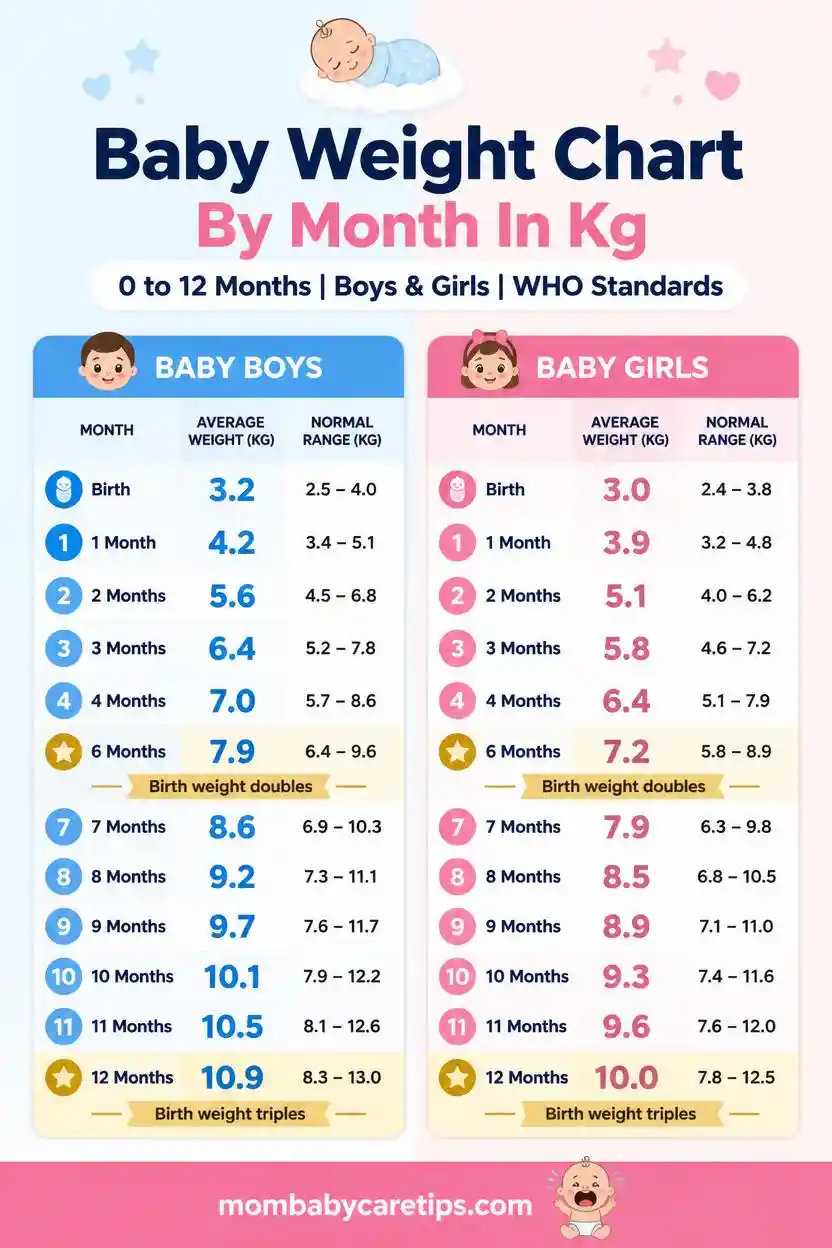
📥 Save this infographic to your Baby Growth board for quick reference.
Month-by-Month Growth: What to Actually Expect
Knowing the numbers is one thing. But what does normal growth actually feel like through the first year? Here is a practical breakdown parents often find more reassuring than any chart.
Birth to 2 Weeks: The Initial Dip
Most newborns lose up to 7–10% of their birth weight in the first few days. This is completely normal and expected — it is mostly fluid loss. By day 10 to 14, the vast majority of healthy, well-fed babies regain their birth weight and start climbing. If your baby had not regained birth weight by two weeks, that is worth a conversation with your doctor — but it does not mean something is seriously wrong.
Learn more about what healthy weight looks like right from day one in our newborn baby weight guide (0–30 days).
1 to 3 Months: Rapid Early Gain
This is the fastest growth phase of a baby’s entire life. Most babies gain roughly 150–200 grams per week through these months. At 3 months, a baby boy would typically weigh around 6.4 kg on average. If your baby seems to be feeding well and is alert and happy, they are almost certainly growing right.
4 to 6 Months: The Doubling Milestone
Most healthy, full-term babies double their birth weight by 4 to 6 months. It is one of those milestones that genuinely feels like a moment. Around 6 months, solid foods often start entering the picture. That transition can cause minor, temporary fluctuations on the scale, which is normal — their gut is just learning to handle more than milk.
For ideas on what to feed your baby to support healthy weight gain after solids begin, our guide on baby weight gain foods (6–12 months) has practical, real-food suggestions.
7 to 9 Months: The Slowdown
Once crawling begins, calorie burn picks up noticeably. Weight gain slows down during this phase and that surprises many parents. If the scale barely moved between the 7-month and 8-month checkup but your baby is active, hitting milestones, and producing plenty of wet diapers — that is almost always a sign of healthy development, not a problem. The body is simply redirecting energy toward movement and brain development.
10 to 12 Months: Approaching the Triple
By the first birthday, most babies have tripled their birth weight. A boy born at 3.3 kg would typically weigh around 9.5–10 kg at 12 months. Keep in mind there is a wide healthy range — a first birthday weight of 8 kg or 11 kg can both be perfectly healthy depending on the child’s growth trajectory.
If your toddler is now past 12 months and you want to track their continued growth, see our toddler boy weight chart (12–36 months) for the next phase of growth.
What Do Percentiles Actually Mean?
Percentiles confuse a lot of parents — understandably. When a doctor says “your baby is in the 30th percentile,” it means your baby weighs more than 30 out of every 100 babies of the same age and sex. Nothing more, nothing less.
The 50th percentile is just an average. It is not the ideal weight or the target to hit. A baby who has been tracking at the 20th percentile since birth is likely healthy — that is simply their personal growth curve. Doctors become concerned when a baby drops significantly across multiple percentile lines in a short period, not because a baby is small.
If you want to track growth consistently over time, the baby weight chart tracker tool can help you plot measurements and see whether your baby is following their own steady curve.
What Shapes a Baby’s Weight?
Weight is not just about feeding. Several different factors influence where a baby lands on the growth chart:
- Genetics: The strongest predictor of a baby’s size is their parents’ build. Smaller parents typically have smaller babies — and that is a perfectly healthy outcome, not a deficiency.
- Feeding type: Breastfed and formula-fed infants often grow at slightly different rates. Breastfed babies frequently gain more rapidly in the first 2–3 months, then slow down slightly compared to formula-fed babies in the second half of the year. Both patterns are considered normal.
- Birth circumstances: Babies born before 37 weeks or with certain health conditions at birth often follow a different curve in their early months. A premature baby’s weight should be compared to corrected-age charts, not standard birth-date charts.
- Illness: A rough week with a stomach virus or a bad respiratory infection can temporarily drop a baby’s weight. Most babies recover quickly once they are feeling better.
- Activity level: As crawling and cruising kick in around 7–9 months, calorie burn increases and weight gain naturally decelerates. This is expected, not alarming.
- Maternal factors during pregnancy: Gestational diabetes can lead to higher birth weight. Certain maternal health conditions during pregnancy may affect birth weight in either direction. These are factors your doctor will already be aware of.
How to Weigh Your Baby Accurately at Home
Home weighing is fine for general tracking, but there are a few things worth knowing to get reliable readings:
- Use a proper baby scale. Adult bathroom scales are not sensitive enough for infant measurements. A digital baby scale that reads to the nearest 10 grams is ideal.
- Keep conditions consistent. Weigh at the same time of day — ideally in the morning, before a feed, with a dry diaper or no diaper at all. Changing conditions between weigh-ins makes comparisons meaningless.
- Do not weigh daily. Babies gain in spurts, and daily weighing just tracks normal fluctuations from feeds and bowel movements. Once every 2–4 weeks is enough at home. Your pediatrician will weigh your baby at every scheduled checkup anyway.
📏 Weight is just one part of growth. Height and length matter too. Track your baby’s length using our baby height chart by month (0–12 months, cm) — or if you prefer imperial measurements, the baby height chart in feet and inches covers the same age range. For toddlers, see the toddler height chart (12–36 months).
When to Talk to Your Doctor
Minor weight fluctuations are a normal part of infancy. But some situations genuinely warrant a call or visit to your pediatrician:
- Your baby has not regained their birth weight by 2 weeks of age.
- There is sudden, unexplained weight loss — not just a slow period, but actual loss.
- Your baby is consistently refusing feeds or showing very low interest in eating.
- Far fewer wet diapers than usual (under 5–6 per day in a newborn).
- Persistent vomiting or diarrhea that is not resolving.
- Unusual lethargy or extreme difficulty waking for feeds.
- Your baby’s weight has crossed downward over two or more percentile lines in a short period — not just sitting low on the chart, but dropping.
These are signs to get checked, not reasons to panic. Most have straightforward explanations once a pediatrician has a look.
More Baby Growth & Weight Guides
This is part of our complete baby growth library. Explore the guides most relevant to your baby’s current stage:
| Guide | Covers |
|---|---|
| Newborn Baby Weight (0–30 Days) | Initial weight loss, regain, day-by-day guidance |
| Premature Baby Weight Chart (Boys) | Corrected age charts for preterm boys |
| Baby Weight Gain Foods (6–12 Months) | Solid foods, meal ideas, what actually helps weight |
| 2-Year-Old Baby Girl Weight & Height | Toddler girls aged 24–36 months |
| Toddler Boy Weight Chart (12–36 Months) | Boys beyond their first birthday |
| Baby Height Chart By Month (cm) | 0–12 months length/height in centimetres |
| Baby Height Chart (Feet & Inches) | 0–12 months in imperial measurements |
| Toddler Height Chart (12–36 Months) | WHO height guide for toddlers |
One Last Thought
Watching your baby grow is genuinely wonderful — and genuinely nerve-wracking at times. The numbers on a scale matter, but they matter most when they are telling a story of consistent, steady growth along your baby’s own curve. A baby who is small but tracking steadily is almost always fine. A baby who suddenly drops across percentiles or stops feeding well is worth checking out.
Use the charts above as a reference, attend your regular checkups, and trust the fact that you are paying close enough attention to even be reading this. That itself says something about the kind of parent you are.
If you want a simple way to keep track of your baby’s measurements over time, the baby growth tracker tool on this site lets you log and visualize monthly progress at a glance.
Medical Disclaimer: The weight data in this article is sourced from WHO Child Growth Standards (2006) and is intended for general informational use only. It is not medical advice and should not replace guidance from your child’s doctor. If you have concerns about your baby’s growth, please consult a qualified pediatrician.
Frequently Asked Questions
What is the average weight of a baby at birth?
Based on WHO standards, the average birth weight for a baby boy is 3.3 kg and for a baby girl is 3.2 kg. A healthy birth weight generally falls between 2.5 kg and 4.3 kg (boys) or 2.4 kg to 4.2 kg (girls). Babies born under 2.5 kg are considered low birth weight and will need closer monitoring, but many catch up well with proper feeding and care.
Is a 5-month baby weight of 6–7 kg normal?
Yes, for most babies. The normal range for a 5-month-old boy is approximately 6.0 to 9.3 kg, with an average of 7.5 kg. For a 5-month-old girl, the range is 5.4 to 8.8 kg with an average of 6.9 kg. A weight of 6–7 kg falls comfortably within healthy bounds for either gender.
What should a 9-month baby weigh in kg?
A healthy 9-month-old boy typically weighs between 7.1 and 11.0 kg, with 8.9 kg being the average. For girls, the normal range is 6.5 to 10.5 kg, with an average of 8.2 kg. Weight slowing down around this age is also normal, as babies become more mobile and burn more energy.
When do babies double their birth weight?
Most healthy, full-term babies double their birth weight by around 4 to 5 months of age, and triple it by their first birthday. These are general milestones — some babies reach them slightly earlier or later, which is usually fine.
My baby’s weight is below average. Should I worry?
Not necessarily. Half of all healthy babies fall below the 50th percentile by definition — that is what “average” means. What matters more is whether your baby is following their own steady growth curve over time. Consult your pediatrician if your baby drops across two or more percentile lines in a short period, or if there are other signs of concern like poor feeding or lethargy.
Is the baby weight chart different for breastfed and formula-fed babies?
The WHO charts, which are the global standard, were built primarily on data from breastfed infants. Breastfed babies often gain more rapidly in the first 2–3 months and then slow slightly compared to formula-fed babies. Both patterns are considered normal. Your pediatrician will account for feeding type when interpreting growth.
How often should I weigh my baby at home?
Once every 2–4 weeks at home is enough for general tracking. Your pediatrician will weigh your baby at every scheduled checkup. Daily or very frequent home weighing is not recommended — normal day-to-day fluctuations from feeds and bowel movements can cause unnecessary worry.
Editorial note: This article is reviewed periodically for accuracy. Growth data is sourced from the WHO Child Growth Standards (2006). This page is not a substitute for clinical advice from your healthcare provider.
Sources
- WHO Child Growth Standards — Weight-for-age Tables (Boys and Girls)
- WHO Multicentre Growth Reference Study Group (2006)
Comments
Be the first to leave a comment!